Solution.--Taking ten feet (height of prism plate
above pavement) off the height of the building opposite, we find the
zenith-tangent to be 0.36, from table of zenith-tangents, column headed
70 (height of building less 10 feet) and row 25 (width of alley). Turning
to page 189, Table of Luxfer Prism Prescriptions,
corresponding to highest light assumed horizontal and to the first row
corresponding the nearest to our zenith-tangent of 0.36, and to column 45°
lowest light below horizontal, we find that canopy A must be used. In order
to find the area of this canopy, we turn to page 211,
table of Luxfer Prism
areas, corresponding to room width 40 feet, and to the table headed "For
Storage," we select the columns headed A, 0.4 because 0.4 is nearest our
zenith-tangent. Here we find 95 square feet needed for a room 50 feet long.
We may therefore order one continuous canopy 2 feet 6 inches deep, by 40 feet
width of room, if we have no columns in the way, or we may divide this area
into single canopies mounted separately over their respective openings.
Reveals.
Fig. C illustrates a section through a window
having a heavy cap or reveal. It is evident that this shadows the
upper part of the window from the sky, and interferes with the work
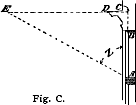 of the prisms placed therein. There are two methods of treating this
case which prove satisfactory, either increasing the depth of the prism
plate enough to make up for the loss arising from the shadow, or setting
out a prism plate called FORILUX, in a separate frame flush
with the face of the wall. In this latter case about 10 per cent should
be added to the area of the prism plate to make up for the light lost
in passing through the undisturbed plate glass in the sash behind the
prism plate. Fig. D shows the method of obtaining the correcting factor
in case it is desired to install the prisms under the reveal. AB is the
depth of the prism plate, the area of which is specified in the table.
of the prisms placed therein. There are two methods of treating this
case which prove satisfactory, either increasing the depth of the prism
plate enough to make up for the loss arising from the shadow, or setting
out a prism plate called FORILUX, in a separate frame flush
with the face of the wall. In this latter case about 10 per cent should
be added to the area of the prism plate to make up for the light lost
in passing through the undisturbed plate glass in the sash behind the
prism plate. Fig. D shows the method of obtaining the correcting factor
in case it is desired to install the prisms under the reveal. AB is the
depth of the prism plate, the area of which is specified in the table.
|


