not the true height, but simply the height above the prism plate.
NOTE PARTICULARLY that by the "building opposite" is
meant, not necessarily the building directly opposite, but the highest
building on the opposite side of the street, and within a range either
to the right or left of half the street width from the point directly
opposite the prism plate.
TABLE OF LUXFER PRISM PRESCRIPTIONS EXPLAINED.
The tables on pages
189-197 show the kinds
of prisms which should be ordered for various conditions. In order to
know the kind of prisms to order in any particular case, it is necessary,
first, to know the direction in which the light strikes the window, and,
second, the directions in which the light is desired in the room. As
explained above, the zenith-tangent gives us all that is necessary upon
the first point. The second point must be determined by a study of
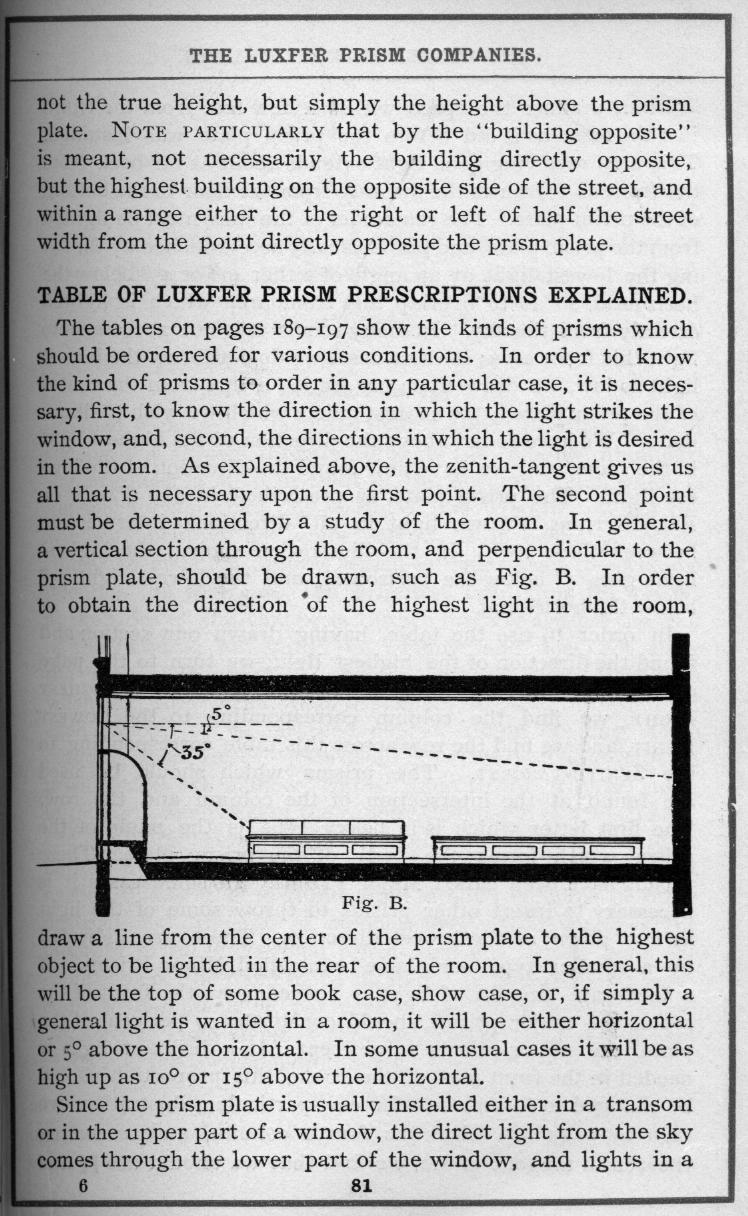
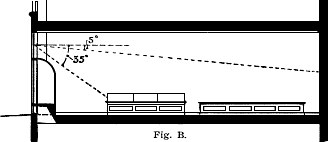
the room. In general, a vertical section through the room, and
perpendicular to the prism plate, should be drawn, such as Fig. B. In
order to obtain the direction of the highest light in the room,
draw a line from the center of the prism plate to the highest object
to be lighted in the rear of the room. In general, this will be the top
of some book case, show case, or, if simply a general light is wanted in
a room, it will be either horizontal or 5° above the horizontal. In
some unusual cases it will be as high up as 10° or 15° above the
horizontal.
Since the prism plate is usually installed either
in a transom or in the upper part of a window, the direct light from the
sky comes through the lower part of the window, and lights in a
|