
Up: Glassmaking

Stained Glass
9 of 29
|
|
| |
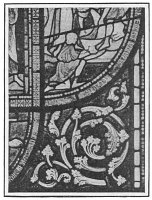
DETAIL OF MEDALLION WINDOW,
CANTERBURY CATHEDRAL,
ENGLAND
|
complete details for the making of stained glass windows.
Concerning the process of making glass, it seems
only necessary to state here that the leading characteristics of glass
making remain today practically the same as when the monks of earliest
times learned from the Greeks the art of glass composition.
Coloring Glass
Theophilus gives exact
directions for mixing the ingredients, composed of sand and silicate
of powdered quartz, or flint, with soda or potash to make the sand
melt under great heat.
To this mixture was added various substances
such as gold, copper, or manganese when colored glass was made. Since
the earliest glass was designed to imitate precious stones, the various
colors produced were called by their names, as ruby, sapphire, emerald,
topaz, amethyst and pearl. While this early glass among the Greeks was
used as much for mosaic wall pictures as for windows, its transparency
was not deemed for first quality of excellence. The various foreign
substances remaining in the materials used by the early glass makers
often produced tints streaked with color, instead of clear, even ones
such as we see in modern glass;
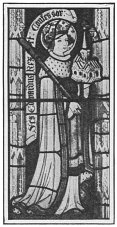
ST. EDWARD THE
CONFESSOR
St. Mary's Church,
Ross, England
|
but this very unevenness gave a quality
to the glass rarely equaled by modern manufacturers.
Blowing Glass
The next process in glass making was that of
blowing the glass into a large bubble by means of a long hollow blow
pipe that had been dipped into a pot of the molten glass. The workmen
then blew the mass into a long cylindrical form, which was later cut
and flattened out by moderate heat in the oven, to a flat piece ready
to use. This is called "muff" glass.
Another process was that of pouring the molten
glass out on a flat surface and spinning it rapidly until cold into a
large flat disk, called a "crown." This is known as "crown glass." All
the early glass was made by these two processes. When the glass was to
be cut to fit a definite shape the workman dipped his finger in water
and ran it over a line where he proceeded to pass a hot iron. Lifting
the piece he then bent it, and broke the glass
|
|