Up: Patent Index |
517,156 · Bruner · "Illuminating-Tile and Method of Constructing Same" · Page 3 Home > Prism Glass > Patent Index > Page 3 |
 517,156: 3 of 5 |
|
Up: Patent Index |
517,156 · Bruner · "Illuminating-Tile and Method of Constructing Same" · Page 3 Home > Prism Glass > Patent Index > Page 3 |
517,156: 3 of 5 |
|
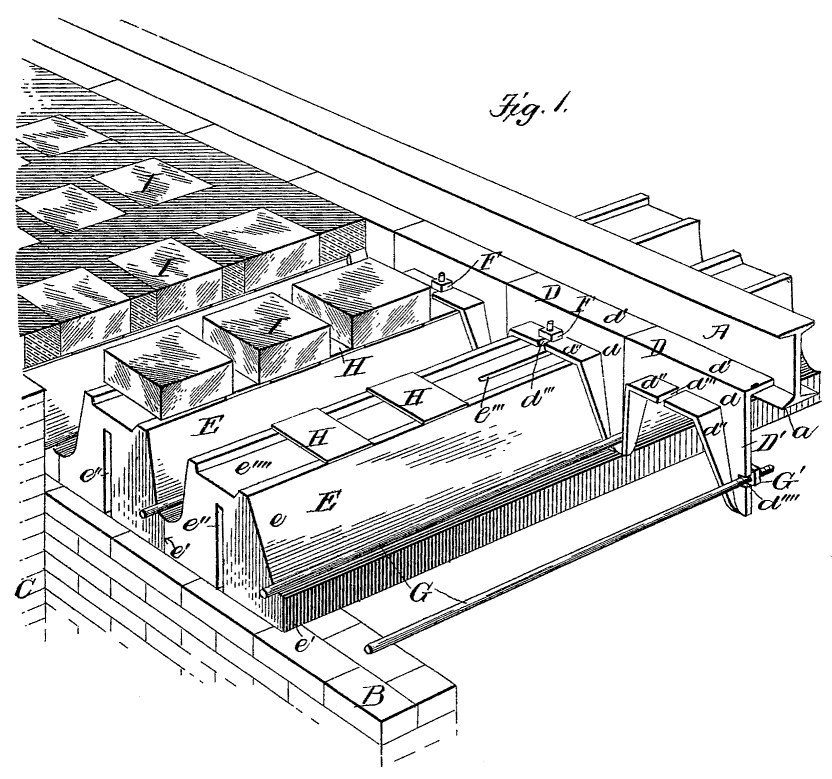
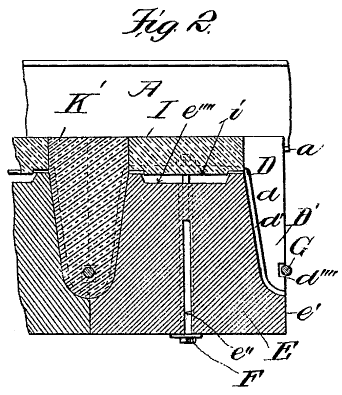
features of improvement in the finished pavement itself. It will be understood that the I-beam A is a fixture in the building and that the area wall B and the street, or other, pavement C, have already been constructed, the desired relative surface levels of the pavement C and of the pavement K (to be constructed) having been predetermined. The height of the area wall is determined, as will appear later, by the vertical thickness of the strips E, and the relative height of the lip a, or corresponding support, by the thickness of the glass lenses I. One of the bracket hangers D is loosely secured to one of the strips E by one of the bolts F and nuts F'. The lip d' of the bracket D is placed on the supporting lip a, the other end of the strip E resting on the area wall B, and the strip E adjusted longitudinally (the elongated bolt holes e''' permitting this), so as to leave the proper space between its end on the area wall and the pavement C to afford a supporting rest, on the area wall, for that edge of the finished pavement K, as is evidently necessary. The nuts F are then screwed tight. A sufficient number to cover the desired space of the strips E and supporting brackets D are placed thus in successive order against each other, as shown in Fig. 1. The rods G are then passed through the recesses d'''' therefore in the brackets D, the area wall ends being supported in proper position by blocking up, or in any desirable manner. The lenses I are then placed in position on the strips E, with the spacing plates H therebetween. The concrete K is then poured or "laid," filling in the intermediate spaces between the lenses and the trenches between consecutive strips E and the space at the ends of the strips B, between them and the pavement C. It is evident that it is not necessary, while perhaps advisable, to build the pavement C before the pavement K is constructed. The pavement C might evidently be replaced by a mold board performing the same function of defining that edge of the pavement K. After the pavement K has hardened or "set," sufficiently, so as to be self-supporting, the strips B are removed. This is done by first loosening and removing the bolts F and then compressing the lower side of the strips E, the slot e'' permitting this, when the strips are easily removed. And, subsequently, the sheets or strips of metal H are removed. It is evident that the nuts F' are embedded in the concrete, and that they are necessarily left in position when the strips E are removed. As illustrated, particularly in Fig. 2, the rods G are embedded in the lower portion of the main ribs K' and act to compensate for any tensile strain that the main ribs K' may be subjected to, strengthening the same. The use of the nuts G', or corresponding head portion, on the rods G, is to prevent any accidental displacement, in the finished pavement, of the supporting bracket hangers D, |
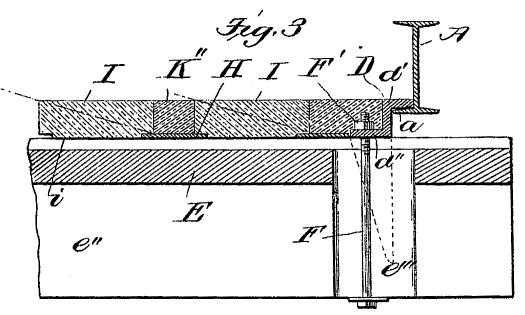
binding, as they do, the brackets D to the body of the pavement K. While the method, as herein outlined, is much more convenient and simple than any heretofore employed, it is very much cheaper. The strips can be adapted, by the bolt slots e''', to span any ordinary area distance and can be used over and over again. Their use also obviates any preparatory, more or less expensive, substructure for supporting the mold structure for the pavement. This is true of any pavement, whether it be illuminating or otherwise, in instances where it is necessary to span an area or space where the pavement has only edge support. But the more important features of improvement, consequent in such a form of construction, exist in its adaptation to an illuminating pavement, and in the consequent inherent features of utility. These features are fully illustrated in Figs. 2 and 3. In monolithic concrete structures of this character, a certain depth or thickness, of parts at least, is necessary for strength. In my improved form of construction, I dispose this thickness in the parallel ribs K', which extend from area wall to building, and place the lenses in the comparatively shallow or thin spaces between the strengthening ribs, making the cross ribs K'', at most, not deeper or thicker than the lenses themselves, thus, as is evidenced by the broken lines in Fig. 3, permitting the transmission of all the light that the thickness of the lenses would permit. It has been heretofore thought necessary to reinforce a pavement of this character by a framing of relatively thicker or deeper dimensions. This I dispense with, and, by the use of the virtually double L-shaped bracket supports, support the "building" edge of my pavement on a support above the lower surface of that part of the pavement in which the lenses are set, thereby obviating any obstruction to the transmission of the light, at that edge of the pavement, into the cellar or basement under the building. Having thus described my invention and its method of application, what I claim, and desire to secure by Letters Patent, is-- 1. The method of constructing area-spanning pavements, consisting in hanging from a suitable support one or more bracket-hangers, temporarily attaching to said bracket-hangers a suitable sub-structure, placing the material on the substructure and against and upon the bracket-hangers, and, finally, removing the substructure and leaving the bracket-hangers to support the edge only of the finished pavement, substantially as described. 2. The method of constructing area-spanning pavements, consisting in suspending bracket-hangers from a suitable support, said bracket-hangers being provided with suitable inwardly-projecting flanges which conform to the contour of the under side of the finished pavement, in temporarily attaching to said |