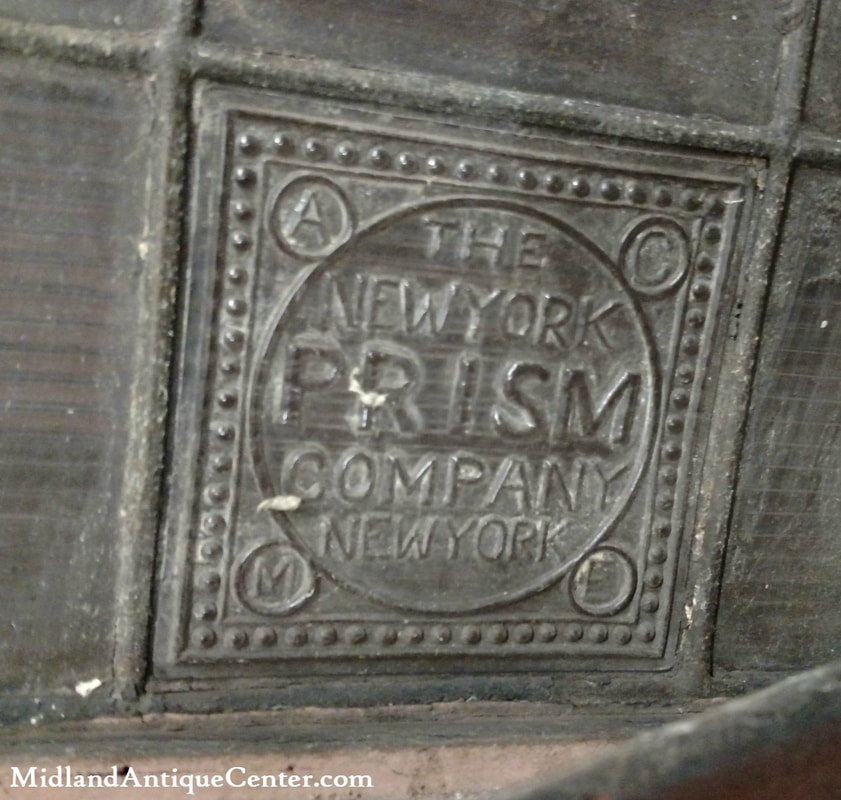
Photo: MidlandAntiqueCenter.com |
Location:
- 473 West Broadway, New York
Timeline:
Notes:
- Started up by Androvette after the Luminous Prism Co
was shut down by Luxfer's lawsuit in 1900.
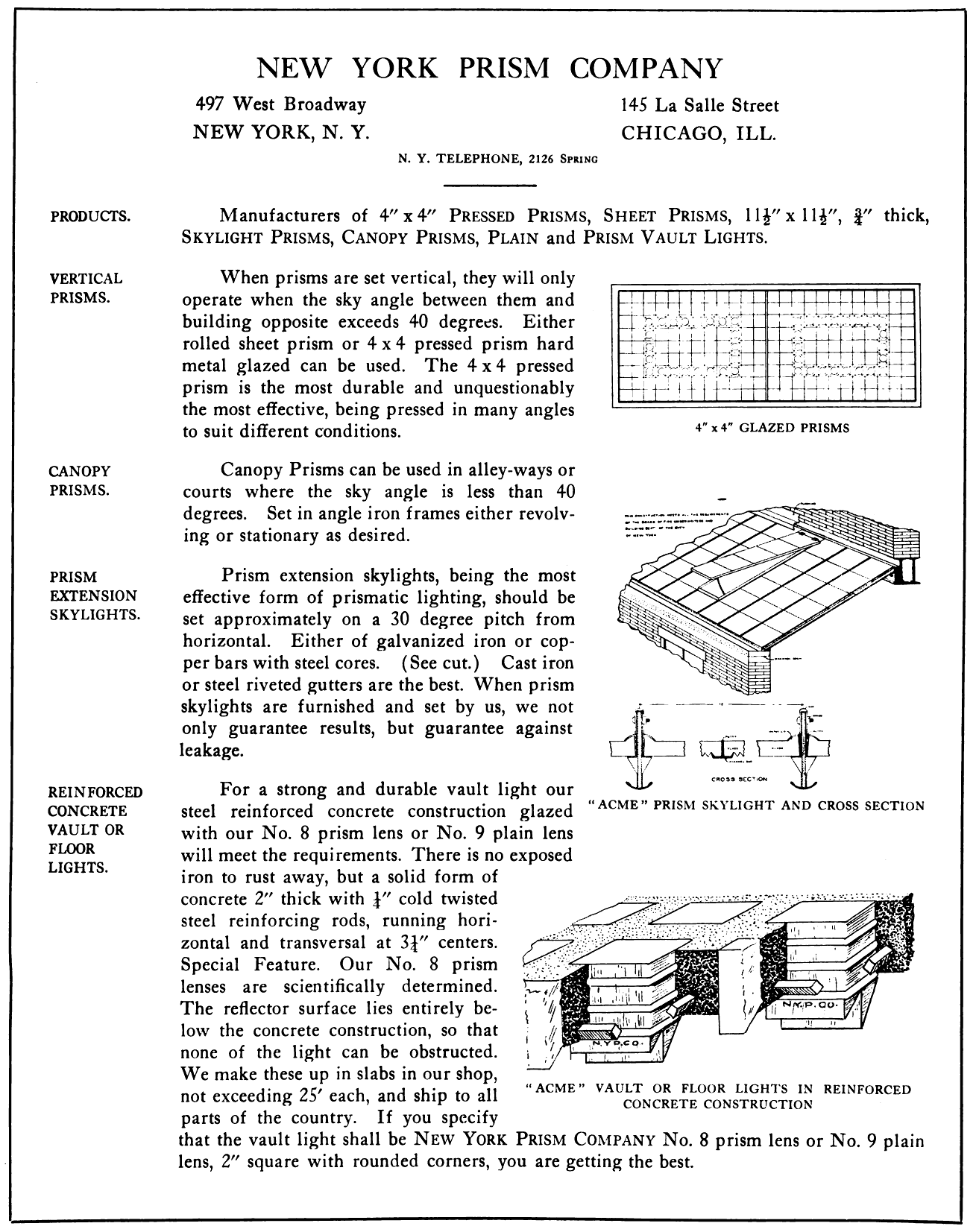
Manufacturers of ACME 4" by 4" PRESSED PRISMS, ACME SKYLIGHT
PRISMS, ACME VAULT LIGHT PRISMS, ACME SHEET PRISM GLASS, ACME VAULT LIGHTS,
ACME IRON CANOPY FRAMES. —Sweet's 1906
- "The
Luminous Prisms. — Another firm which has begun
to do some work in the way of school installations is the New
York Prism Company, of 473 West Broadway, New York. Their business
thus far has been principally with private schools, tho they have
had some orders from the boards of education of Philadelphia,
Cleveland, and Chicago. In New York city they have supplied
prismatic glass to the following institutions: The Normal college;
the Brearley school; the Berkley school; the Cornell medical college;
the Chapin Collegiate school. This prism company has recently printed
Natural Light for School-Rooms, an essay addressed to
the National Educational Association, at Charleston. In this essay the
facts about prismatic lighting are very succinctly and forcibly stated.
It should be in the hands of every student of school hygiene in the
country. This firms employs a lucical engineer who makes scientific
studies preparatory to each installation." —The School Journal, December 1, 1900
- "George E. Androvette. Pres.; J. Franklin Blanchard, Sec. Capital,
$10,000. Directors: George E. Androvette, J. Franklin & Emma
Blanchard" —The Trow (formerly Wilson's) Copartnership and Corporation Directory of New York City, Volume 49, 1901
- Patent No. 705,372 by G. E. Androvette: Prism Glass for Skylights, 1902
- The Architect's and Builder's Pocket-book · 1904
- "N. Y. Prism Co. (N. Y.) (George E. Androvette. Pres.; J. Frederick
Wordworth, Sec.; William E. Cash, Treas. Capital. $10,000. Directors:
George E. Androvette, William E. Cash, J. Frederick Wordworth)
473 W. B'way" —The Trow Copartnership and Corporation Directory of the Boroughs of Manhattan and the Bronx (City of New York) · Volume 52, 1904
- Thomas Register of American Manufacturers ·
1905-06
- Sweet's Architectural Catalog File · 1906
- "Mr. Geo. E. Androvette, the president of the New York Prism Company,
of 473 West Broadway, has been striving to convince property owners
and tenants, as well as architects and the world generally, that
prisms solve a problem which nothing else can, for many years.
"The day dawns at last," said Mr. Androvette, "and prisms are no
longer an experiment with the public, but tenants and owners are
demanding their installation." Real Estate Record and Builders' Guide · Volume 77, 1906
- "N. Y. Prism Co. (N. Y.) (George E. Androvette, Pres.; Kenneth G.
White, Sec. Capital, $10,000. Directors: George E. Androvette,
Kenneth G. White) 497 W. B'way" —The Trow Copartnership and Corporation Directory of the Boroughs of Manhattan and the Bronx (City of New York) · March, 1908
- "Mechanics' Liens. ... 125TH ST. 543 West; New York Prism Co. against
Cataline de Vere Potter, owner; Octave D. Potter, contractor, $146"
—New York Times · December 15, 1908
- "New York Prism Co. A. Willkomm, Agt., 779 Market St., S.F."
—Western Architect and Engineer · Vol. XIII, No 2, 1908
[Willkomm Building Supply Co.]
- "Recorded Mechanics' Liens. ... 125TH ST, 161 East; New York Prism Co
agt Emma L Harris and Sarah C Mitchell, owners; Joseph Wielar &
Co, lessees; F Siegel & Co, contractors ... $410"
—New-York Tribune · October 26, 1909
- "Mechanics' Liens. ... 34TH ST. 142 East; New York Prism Co. against
Carl Damschinsky, owner; D. J. Comyns & Co., contractor, $800"
—New York Times · August 18, 1910
- "Judgments. ... Schoenberger, William—New York Prism Co., $115"
—New York Times · September 29, 1911
- "WARRANTS MADE READY FOR PAYMENT IN DEPARTMENT OF FINANCE ·
[Invoice date] 11-17-17 [Received] 2-20-18
[Name of Payee] New York Prism Co [Amount] $18.00"
—The City Record · Vol. XLVI, Number 13621, March 6, 1918 (PDF)
- "N. Y. PRISM CO., 509 W Bway" —White-Orr's Reference Register · 1918-19
PRISM LIGHTING.
The term prism lighting does not convey
its full meaning to all. Direct light is transmitted only in straight
lines. Everybody knows that. Given a room with two windows, or a basement
with two skylights, with ordinary glass, direct light will be obtained
only in front of the windows or directly beneath the skylights. The
light elsewhere in the room will be only diffused. By the scientific
use of prisms, however, a direct light can be thrown to any part of a
room. Prisms are small squares of glass, smooth on one face, and moulded
with rows of projecting ribs of varying depth and of differing angles on
the other face, which, when scientifically applied utilize the principle
of refraction to a degree that is a revelation to those not familiar with
their working. The effect of an adequate prism installation of proper
angle, is in fact the same as placing every part of a room at such an
angle that the sky could be seen through the openings. Prism lighting is
by no means purely mechanical and simple, for each room requires special
study and treatment. The application of the various angles to meet and
overcome varying conditions make scientific problems of each proposed
installation. For the varied devices for directing light the New York
Prism Company, 473 West Broadway, New York, stands pre-eminent: and its
president, George E. Androvette, is a pioneer in prism lighting, and is
eminently qualified to direct the scientific and mechanical features
of prism construction. J. Franklin Blanchard, secretary and treasurer
of the company, is throughly conversant with all points bearing on the
efficient installation of prisms, and his long training in architectural
and building interests gives special value to his services in this line.
Every facility that experience can suggest
for the prompt and satisfactory completion of contracts is provided,
and a positive guarantee given for superior mechanical construction
and the best results that can possibly be obtained by the use of prisms
under any given conditions. Estimates of cost of equipping any premises
will be made on application, with clear statement of results that can be
obtained. To those at a distance, blanks will be furnished to be filled
out, and all inquiries will receive prompt and courteous attention.
Journal of Education · Vol. LX, No. 8, August 25, 1904
|
EFFECT OF LIGHT ON SIGHT.
To have a schoolroom well lighted, it
is necessary to have ample window space on two sides of the room and
no obstruction to the light opposite the windows. When opposite
buildings darken the windows, prism glass installed in the top sash
will remove the shadow and produce as much light as if no such
buildings existed.
Under any and all conditions the use of
prism glass increases the light, improves the sanitary conditions and
saves the eyesight of children, because it brings in and distributes the
light uniformly to all parts of the room, giving every scholar equally
good light.
It is admitted that defective eyesight and
the use of eyeglasses are constantly increasing. Is it not plain that the
cause is bad light? Is not our remedy most important to consider?
Sheet prism glass used instead of common
glass will cost no more than plate glass, and is a cheap remedy for bad
eyesight. This question deserves equal consideration with heating and
ventilating by architects and school committees.
For further information address Mr. Geo. E.
Androvette, Lucical Engineer, or the New York Prism Co., 473 West
Broadway, New York.
The American School Board Journal · Vol. XXX, No. 1, January, 1905
|
THE VALUE OF PRISM GLASS.
Wherever an interior admits insufficient day
light, making the use of artificial light compulsory, prism glass will pay
for itself in two years in the saving of artificial light. It is therefore
economical as well as beneficial to the sight. Its practical value
demonstrates itself. It removes all shadows, brings in the natural light
in its full volume and natural light is the only healthy light.
In the form of sheet prism glass its
installation is as simple as common glass and only the same care is
required to maintain and keep clean. Attention must be paid to but one
essential—have the proper angle of prism suited to the special
conditions existing at each opening, and have the glass set with the ribs
running horizontal, the short angle on top and the smooth face out.
Prism glass is only required to be set in
the top sash to obtain the results desired. Set in the bottom sash it
increases the light very little, as it can only raise the light at the
window and distribute it over the entire room by being placed as near
the ceiling as possible.
It will make a room more light on a dark
and cloudy day than at any other time, simply from the color effect of
the sky. In this way weather conditions cause no diminution of light
when prism glass is used. If on a sunny day the prism glass makes too
bright a light (as it sometimes will), white Holland shades over the
glass will soften the light pleasantly.
May not the restlessness of children in a
schoolroom, in a measure, be attributed to their eyes becoming tired
because of insufficient light? If so, the use of prism glass would
be helpful in this way in addition to saving the eyes. Therefore,
it should be installed whenever its use would increase the natural light
in a schoolroom.
Any Architect or School Committee desiring
full information as to the use and cost of prism glass will do well to
write to Mr. Geo. E. Androvette, Lucical Engineer, 473 West Broadway,
New York.
The American School Board Journal · Vol. XXX, No. 2, February, 1905
|
DIFFUSED LIGHT FOR TEXTILE MILLS
One of the main requisites in textile
mill construction is to make certain that every part of the finished
structure is well lighted by natural daylight. All of the processes in the
manufacture of cloth demand good light; without it, the operatives are
unable to detect and correct imperfections. In many textile mills there
is a great deal of waste space where no machines are located because of
the fact that there the daylight does not penetrate to such an extent
that perfect manufacture of cloth is possible. In other instances,
it is necessary for the manufacturer to use artificial light during
the morning and afternoon. This, of course, is done at a considerable
cost, and could be wholly obviated provided the daylight was brought
into the mill and diffused. Particularly in weaving is it necessary to
have perfect light. Because of this, many manufacturers have found it
necessary to locate their weave shops in large, one-story buildings,
having the roof almost wholly of glass. It is well known that the most
expensive parts of mill construction are the foundation and the roof;
consequently, a weave shop such as this is a very expensive building to
construct. In wool sorting, also, the sorters can only work by daylight,
as artificial light casts so many shadows that it is not possible for
the most experienced sorter to determine the grade of the wool which he
is handling. Provided in this case the daylight hours were lengthened,
as they can be lengthened by a perfect diffusion of the daylight,
a considerable saving would be the result. In the finishing room,
also, where the cloth is examined, it Is often necessary to work by
artificial light during the morning and afternoon. This, also, could be
obviated by the above-named methods. The textile mills, built as they
are of stone and brick, at a time before steel construction was common,
are necessarily lighted by small window spaces. Another reason, also,
why small windows are used is because of the fact that the larger the
window space the more expensive it is to heat the buildings during the
cold months. Now these windows are hardly ever of sufficient number or
size to thoroughly light the centre of the room.
The New York Prism Co. manufactures and
installs windows of prismatic glass, making a study of every individual
case and constructing the windows so that the light is thoroughly
diffused and the darkest corners of the room well lighted by natural
daylight. In this manner the cost of artificial light is done away with,
and more nearly perfect cloth is produced.
GEO E. ANDROVETTE, Lucical Engineer.
America's Textile Reporter · March 1, 1906
|
Gathering Daylight.
The scientific effect in the divergence
of the rays of light when falling upon prisms has long been, known and
often demonstrated, like many other technical facts, as matters only
interesting to the cultivated mind. Years ago the manufacturers who
sought to make prisms known as a great factor In the lighting of dark
rooms, found that the world needed educating on the subject. This has
been going on gradually on both sides of the Atlantic during the past
twenty years. To-day it seems that there is a greater realization of
the prisms value than ever. Property is more desirable where they are
installed, because they render artificial light as unnecessary as it is
undesirable in the day time.

Interior in Saks & Co.'s Store, Showing Effect of Prism Lights
|
One of the most notable examples of prism
lighting in New York Is in the building of Butler Bros., at 495, 497 and
499 Broadway. This is a large building of 7 storeys, every one of which is
lighted by prisms. Where tall structures are on every side it would be
impossible for the direct rays of the sun to reach more than a few feet
into the store through ordinary windows, but when this light strikes the
prisms it branches out at a direct angle and floods the interior with
a natural, delightful radiance. Butler Bros., like many other firms,
are not slow to acknowledge the benefits they derive from the use of
prisms. Anyone may note the prisms along the windows of the great
clothing store of Browning, King & Co., opposite Cooper Institute,
and see the natural light of day within diffused by the prisms.
One of the famous 5 and 10 cent store
corporations, the S. H. Kress Co., whose New York offices are at 379
Broadway, have fitted up over forty stores in different cities of the
United States with prism lights. Mr. C. H. Kress, who is at the head of
the construction department of this corporation, said the other day that
prisms made their property more valuable everywhere because they brought
daylight where it could not otherwise be. They light the interior
with natural light, said Mr. Kress, and our employes are in good
health and happier than could be possible if we were compelled to use
gas or electricity.
Mr. Geo. E. Androvette, the president of
the New York Prism Company, of 473 West Broadway, has been striving to
convince property owners and tenants, as well as architects and the world
generally, that prisms solve a problem which nothing else can, for many
years. The day dawns at last, said Mr. Androvette, and prisms
are no longer an experiment with the public, but tenants and owners are
demanding their installation.
The illustration is a direct reproduction
of a photograph of an interior of one of the departments of Saks
& Co.. New York, which gives a fair idea of how prisms radiate the
light. Prisms can now be made in large sheets so that it is not necessary
to always use the window frames of steel in which the small prisms
were electrolytically fixed. Many, however, prefer the small square on
account of their great strength and fire retardant qualities. The large
prism sheets are being installed in factories and many buildings where
there are great surfaces. Forty thousand ft. have been installed in the
American Woolen Company's mills at Lawrence, Mass., recently. The prism
sheets can also be made with a wire mesh embedded within in the manner
of wire glass. A great future looms ahead for the prism business.
Real Estate Record and Builders' Guide · Vol. LXXVI, No. 1998, June 30, 1906 (PDF)
|
WHAT PRISMATIC LIGHTING SPRANG FROM.
Most people do not understand the system
of lighting dark rooms by the use of prism glass. This system was first
inaugurated by Mr. George E. Androvette in Chicago, in 1886, by using
glass having a smooth face outside and prisms on the inner surface to
change the natural direction of light.
This was accomplished to the entire
satisfaction of the architect and owner of a building at 35th st and
Wabash ave, since which time Mr, Androvette has devoted his whole time
lo the development of a system of prismatic lighting which embraces
the use of prism glass In sidewalk lights, in extension skylights (the
most effective form of prismatic lighting) and also by use of prism
glass canopies over windows in narrow areas where it had hitherto been
impossible to obtain natural light.
These methods of installation enabled him
to contend with the difficult problems induced by the advent of tall
buildings In close proximity which exclude the natural light.
The simpler problems, such as using prism
glass In windows and transom sash, in stores, schools and factories
have been achieved by the use of pressed prism units, 4×4 inches,
glazed in hard metal electro copper plated, also by glazing sheet-prism
glass in lieu of window glass in windows of all kinds.
The one essential is that, should you buy
prism glass for lighting purposes, you should see that it is furnished
and set by a prism-glass company who fully understand the surrounding
conditions, which will enable them to specify and use the angle of glass
that will effect the object intended.
Prism glass is frequently installed by those
who have no technical knowledge and has failed to produce results. This
is simply the result of a lack of knowledge, and should be guarded
against. No ordinary glass dealer can comprehend the conditions without
advice from a prism glass expert, Mr. Androvette, 497 West Broadway,
will be pleased to advise any architect or owner as to the method by
which the hest results can be attained.
Real Estate Record and Builders' Guide · Vol. LXXXI, No. 2089, March 28, 1908 (PDF)
|
Prismatic Lighting.
By GEORGE E. ANDROVETTE,
Lucical Engineer.
Prismatic lighting has become an important
factor in modern buildings. The more intelligent public appreciate the
value of natural light. The congested conditions involved in cities
exclude the natural light, which in most cases can be restored by the
use of various forms of prismatic glass, which changes the direction
of light from vertical to horizontal lines and illuminates interiors
previously dark unless lighted by artificial lights, which, aside from
expense, are not equal to natural light.
There are several forms of prismatic
lighting—window prisms, extension skylights, prism canopies, and
sidewalk lights. Each method involves the use of glass having prism
forms calculated to operate under a given condition, for the reason that
the limitations of natural laws of light must be considered and either
refraction or reflection must be used. The writer has had twenty years'
experience exploiting the possibilities of this work, and any person can
command his services, free of charge, to explain and suggest the most
effective methods. Exterior conditions govern the methods to be employed,
and success depends on intelligent installation.
Western Architect and Engineer · February, 1909
|
|