Up: Glassmaking

How Bottles Made
8 of 18
|
|

| |

|
THE ideal glass would be made of pure sand. But as
pure sand cannot be melted, other elements must be added.
Soda ash will melt the sand, but forms a silicate which is
soluble in water. Hence, additional ingredients must be
used. Limestone and feldspar give the needed resistance
to weathering and the action of water. Cullet, or waste
glass, is added both to regain the waste and to improve
the working qualities of the mixture, while borax reduces
the coefficient of expansion and makes the finished product
better able to stand temperature changes. Barytes cleans
the glass and gets rid of all gases, while various
decolorizers are used to neutralize anything which might
keep the glass from being clear and white.
The ingredients of glass vary with the color desired. All
glass contains sand, soda ash, cullet, feldspar, borax and
barytes. In addition to this, flint glass contains burnt
dolomite lime, arsenic, and two decolorizers.
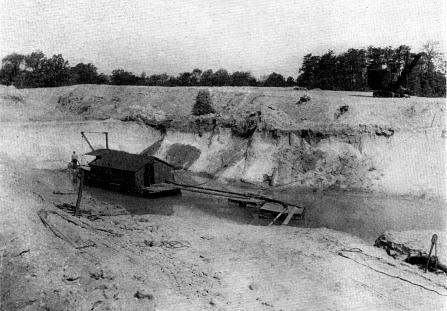
Sand is the principal ingredient in bottle manufacture.
Many kinds of sand are used by different manufacturers because
of necessity. But it is generally accepted that the very best
deposit of bottle sand is only three miles from Millville,
N.J., and is owned by the Whitall Tatum Company. Above you
see part of the pit, the sand being dredged out by hydraulic
machinery and pumped to the cleaning and storage sheds.
Operators watch for prehistoric bones buried here. Also for
"lightning canes" made by lightning striking the sand and
fusing it into a crude glass.
|
|