Up: Glassmaking

Lens Story: 9 of 28
|
|
| |
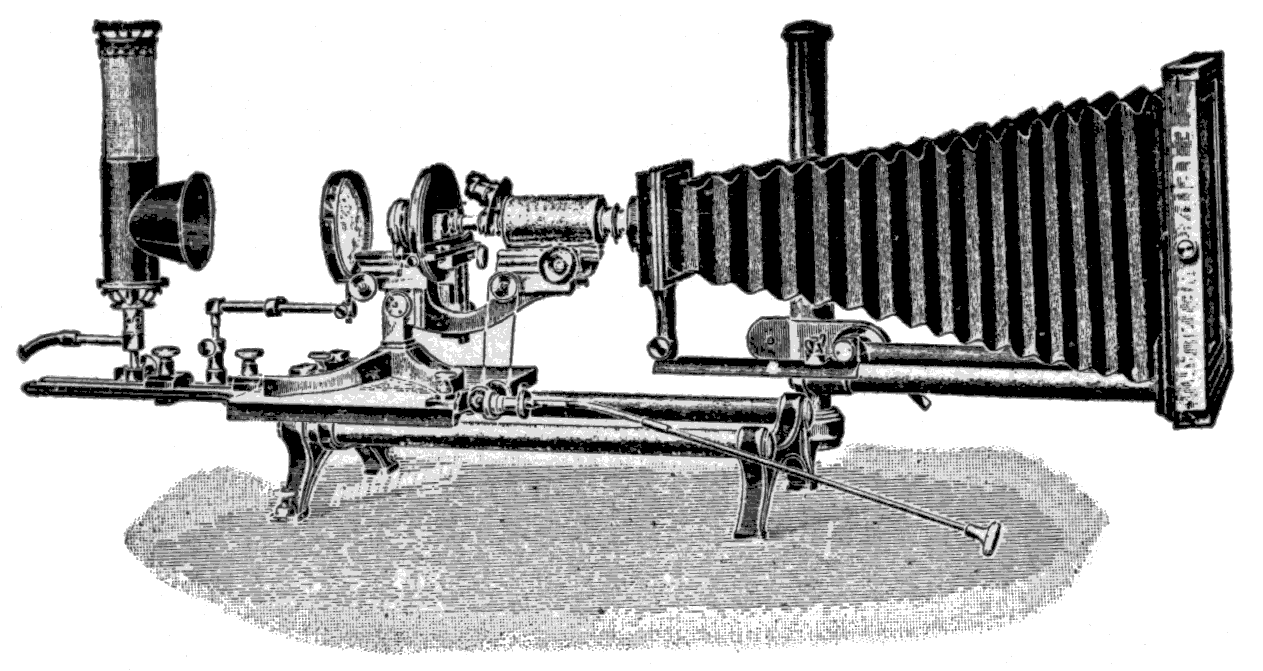
 UNIVERSAL PHOTOMICROGRAPHIC APPARATUS
(Horizontal position)
|
astronomical and microscopic lenses, thereby
reducing this art to an exact science, was
Professor Abbe of Jena.
For grinding, the big lens is cemented with pitch
to an iron plate mounted on a spindle. Emery or some other abrasive is
sprinkled on the glass and another iron plate placed above, which is
shoved hither and thither over the surface. Finer and finer grinding
materials are used, and for the final polishing cloth covered tools and
rouge. Very frequent tests of the glass are made. Pieces are chipped
off and examined with the spectrometer for their indices of refraction.
It is upon these measurements that the mathematical calculation of the
curvature is based.
As already shown, a telescope objective consist
of two lenses: one convex and made of crown glass, the other concave and
made of flint glass. Therefore two lenses must be ground simultaneously
and fitted together with the utmost precision. In the final grinding and
polishing, tools having an exactly opposite curvature to that required in
the lens itself are employed. In testing the accuracy of this curvature,
the lens is placed in a "test glass" also of exactly opposite curvature.
Between the two surfaces of glass will be a very thin film of air which
will give rise to a color effect just as is observed in soap films viewed
in sunlight. When the thickness of this air film is everywhere the same,
the color appearing will be uniform over the whole surface.
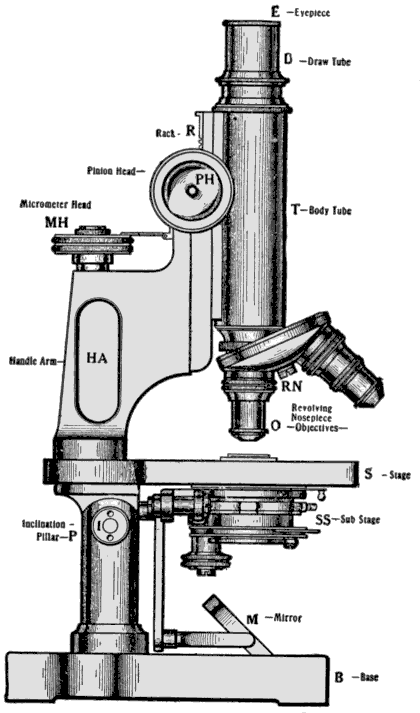
 A STANDARD MICROSCOPE
|
In this manner deviations in curvature
of only one two-hundred-fifty-thousandths of an inch may be detected.
Each lens is then centered in a lathe and the edges ground, after which
the two lenses are placed together and mounted for final testing in the
telescope tube.
Uses of the Lens
Try to imagine for a moment what this world
would be without spectacles, the camera, the microscope, binoculars,
field glasses and the stereopticon, and you will only just begin to
appreciate something of the immense significance of the lens in the
affairs of men.
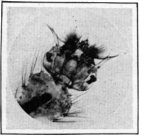 Courtesy P. O. Gravelle, South Orange, N.J.
LARVA OF MOSQUITO
Magnification 14 diameters
|
The purpose of a lens always is so to bend the
rays of light passing through it as to form an image of some object,
or to assist in the formation of an image. The ordinary hand magnifier
affords one of the simplest illustrations. We hold it a certain distance
from an object, and a magnified image appears. This is a virtual image.
It could not
|
|